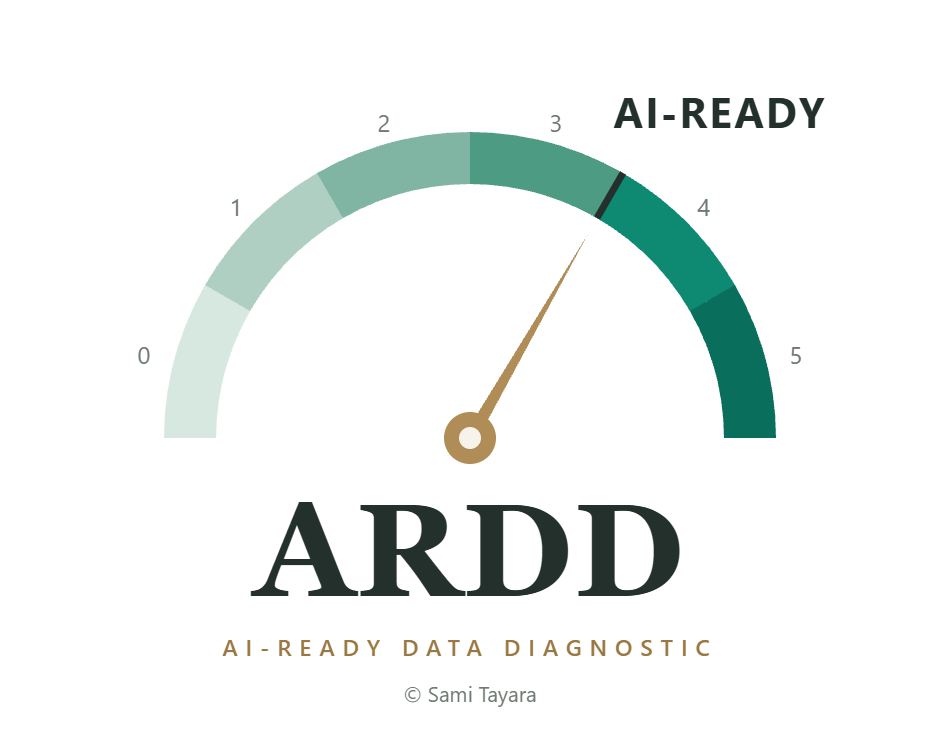
I wrote this practitioner article to introduce the AI-Ready Data Diagnostic (ARDD) in an accessible form, drawing on my academic research. My full research paper contains the detailed measurement model, assessment criteria, research foundations, and evaluation.
I developed ARDD to assess the data foundation for enterprise AI against an organization's named priority use cases. ARDD is a separate authored work with its own research publication.
ARDD connects data-management maturity with the requirements of the AI use cases the organization intends to operate. The assessment identifies the capabilities that support those uses and the weaknesses that require attention.
What ARDD assesses
The foundation tier comprises nine dimensions: Data Quality & Fitness; Lineage, Provenance & Auditability; Meaning & Semantics; Sufficiency & Representativeness; Ownership, Stewardship & Decision Rights; Rights & Permissible Use; Access, Security & Privacy; Architecture & Accessibility; and Sovereignty & Residency.
Two contextual dimensions accompany that assessment: Activation Readiness and Delegated Authority. They address the connection to AI value and the governance of authority delegated to AI systems. They are reported separately from the foundation scores.
The ARDD overview introduces the dimensions and maturity scale. The published paper contains the measurement model, assessment criteria, and research foundations.
Assess readiness for named use cases
ARDD anchors the assessment to named AI use cases. Seven foundation dimensions are assessed per use case. Architecture & Accessibility and Sovereignty & Residency are assessed at organizational level and inherited into each use-case profile.
This structure connects findings with the data an AI use case needs, its intended purpose, and the conditions under which it will operate. It also identifies shared capabilities whose improvement can support several use cases.
Read the floor before the index
Foundation dimensions use cumulative, whole-number maturity levels from 0 to 5. A level is attained when its criteria and the criteria of all lower levels are met.
The weakest foundation dimension determines each use case's floor. The lowest use-case floor sets the organization's reported band. This non-compensatory rule keeps a critical weakness visible even when other dimensions score well.
The averaged foundation index provides a secondary view of direction. Activation Readiness and Delegated Authority are excluded from both the foundation index and its floor.
ARDD alongside TWAF
ARDD assesses the data foundation. The Two Wings AI Framework assesses AI initiatives across value and trust, with governance spanning both wings and the AI Decision Gate. ARDD findings can inform the AI-Ready Data foundation of TWAF's trust wing.
Each work has its own scope, authorship, and publication. ARDD can be used to assess data readiness in its own right.
Publication and authorship
Sami Tayara is the author of The AI-Ready Data Diagnostic (ARDD): A Maturity Assessment Model for the Data Foundation of Enterprise AI.
The paper presents a design-science maturity model evaluated through coverage mapping against seven references. Its empirical evaluation, including assessor reliability and field performance, remains a research step.
Read the paper on SSRN, or explore the ARDD overview. The paper's DOI is 10.2139/ssrn.7332259.